The first period is different from the next
Before we go into details: your first period is almost always milder and shorter than those that come after. The body is learning something new, and it happens gradually. For the first few years, your period will typically vary greatly from time to time – in duration, amount and appearance. It is not a sign that something is wrong. It is the body that slowly gets to know a whole new system.
The color – what is normal?
This is where a lot of young girls are surprised. Because menstrual blood is not always bright red.
Light brown or dark brown. The first period very often starts as light brown or dark brown discharge – not as the red blood you might have imagined. This is because the blood has taken some time to come out, and that contact with oxygen makes it darker. It is completely normal and very common as the very last start of a period.
Red – from pink to dark red. When the bleeding is at its heaviest – typically on days 1–3 – the blood is usually bright red. Pink blood is a mixture of blood and discharge and is often seen at the beginning or end. Dark red is seen when the blood has spent a little longer in the body, for example in the morning after a night’s sleep. All of this is normal.
Black or very dark. Dark, almost black blood at the start or end of your period is not dangerous. It is old blood that has taken a long time to get from the uterus out. The color is a sign of speed – not of anything wrong.
When should you talk to an adult? If your blood is grey, greenish or smells very strong and different, it is a good idea to talk to a healthcare provider or doctor. It can be a sign of an infection that can be easily treated.
The amount – how much do you bleed?
Here’s the most important thing to know: first menstruation is usually very sparse. Many girls only bleed very little the first time – some just experience a small spot in their underwear, others a little more.
In general, an average of 35–80 ml of blood is excreted during a full menstrual period. It sounds like a lot, but spread over 3–7 days it is actually not huge. In comparison, one tablespoon holds about 15 ml.
The first few days are usually the strongest. Approximately two-thirds of the bleeding occurs during days 1–3. After that, it gradually decreases.
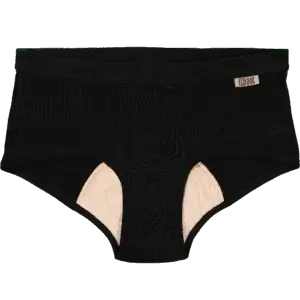
When you should change your menstrual product depends on what you use – and how much you bleed. With period underwear, you can keep up by checking the bright inside: when you can see that it’s saturated, it’s time to change.
When should you talk to an adult? If you soak a normal menstrual product in less than two hours, or if you experience large blood clots (larger than a coin), it’s a good idea to talk to a doctor. Very heavy bleeding can have a cause that can be easily helped.
The duration – how long does it last?
A normal period lasts between 3 and 7 days. In most young girls, the first period is shorter – perhaps only 2-3 days – and often sparse.
For the first 1–2 years, it is quite common for periods to vary greatly in duration. Once it lasts 3 days, the next time 6. It is a natural part of the first years of menstruation and it stabilizes over time.
The cycle – i.e. the time from the first day of one period to the first day of the next – is on average 28 days, but anything between 21 and 35 days is considered normal. In the first few years, it can take anywhere from a few weeks to several months between periods. It is not dangerous.
A good tip: write down the date every time your period starts. Just a small “M” in your calendar or in an app. Over time, you will begin to see your own pattern.
When should you talk to an adult? If your period lasts more than 7 days, or if your periods are more than 3 months apart (and you’ve had them for over 2 years), it’s a good idea to talk to your healthcare provider or doctor.
Pain – what is normal and what is too much?
One of the things that a lot of young girls are nervous about is pain. And yes, some soreness in the stomach is normal – but it doesn’t have to mean that you have to lie down for days.
What to expect. Most girls notice a slight to moderate pulling or cramping sensation in the lower abdomen, especially on days 1–2. This is because the uterus contracts to expel the mucous membrane. Some also feel it in the lower back. It is normal and usually subsides on its own over a period of time.
It can help to:
- Place a warm pillow or towel on your stomach
- Go for a short walk or do light movement – it actually helps many
- Drink something hot – hot tea or cocoa
- Rest, if the body asks for it
When is the pain too much? Pain that is so severe that you can’t go to school, play sports or manage your everyday life is not something you just have to accept. It is perfectly legitimate to talk to a doctor about it. There is good help available – both in the form of painkillers and other solutions.
Talk to an adult or doctor if:
- The pain is very severe and interferes with everyday life
- You faint or vomit from pain
- The pain is located elsewhere than in the stomach and lower back
Clots in the blood – is it normal?
Yes, small blood clots are normal and are caused by the blood clotting easily on the way out. This is especially seen on the heaviest bleeding days.
Lumps the size of a pea or a small coin are harmless. Very large lumps that recur should be discussed by a doctor.
The first periods are irregular – and that's okay
This is one of the most important things to know: for the first 1–2 years, almost all periods are irregular. The body is not a machine that turns on at the exact same time every month. It is learning.
This means that your period may come too early, too late or not even a month – and it doesn’t say anything about something wrong with you. It’s a sign that your body is still establishing its own pattern.
That’s why period underwear are practical at first: you can wear them as a kind of preparedness, even on days when you’re unsure if your period is coming.
When is it a good idea to talk to an adult or a doctor?
You never have to have a “good enough” reason to ask for help. If something worries you, it’s enough to talk to your healthcare provider, a parent, or your doctor. But here are the specific situations where it is extra important:
- The blood is grey or smells strong and different than normal
- You soak a menstrual product in less than two hours
- You have very large blood clots repeatedly
- The pain is so severe that you can’t cope with everyday life
- Your period lasts more than 7 days
- You are over 16 years old and have not yet had your first period
- There are more than 3 months between periods (after you have had them for more than 2 years)
Frequently asked questions about normal first menstruation
Can you have your first period for just 1-2 days? Yes. The first period is often very short and sparse. Some people experience just a single day with a little light brown discharge. It’s completely normal.
Is it normal that there will be no blood next month? Yes, the first 1–2 years the cycle is almost always irregular. It can easily take 2–3 months between periods. Write down the date when it arrives and follow the pattern over time.
Is it normal to have a stomach ache before your period starts? Yes. Many girls feel a slight pulling or upset in the stomach a few days before the bleeding starts. It is the body’s preparation.
Is it normal for the stomach soreness to be stronger the first few times? Yes. Primary menstrual pain – i.e. those experienced in the first few years – can be more severe, and many people find that they decrease the more regular the cycle becomes.
My period was brown and not red – is that normal? Yes, it is very common. Brown blood is oxidized blood that has taken some time to come out. It is not a sign that something is wrong.
Your body is doing the right thing
Whether your first period was a small brown spot or a full day of bright red blood – your body is doing what it’s supposed to do. There is no one right way to have a period. There’s your way.
Want to know more? Read our guide on the signs of your first period or when to get your first period. And if you are looking for a safe first menstrual product, you can check out our period underwear for teenagers.